Some women’s health problems cannot wait for a regular office visit. An ectopic pregnancy, a twisted ovary, a ruptured cyst, or heavy bleeding that leads to blood loss can become life-threatening within hours. Knowing the warning signs helps you decide quickly instead of second-guessing yourself at 2 a.m. Here is how to tell the difference between pain that can wait and pain that belongs in the emergency room, and what happens once you arrive at Life Savers ER.
When to go to the ER for pelvic pain
Pelvic pain that appears suddenly and severely, especially on one side, is the kind that needs same-day emergency care. Ovarian torsion happens when an ovary twists on the tissue that holds it in place, cutting off its blood supply. The pain is often sharp, one-sided, and comes with nausea or vomiting. The ovary can be saved, but only if it is untwisted quickly.
A ruptured ovarian cyst can cause similar sudden pain. Many small cysts rupture without trouble, but some bleed inside the pelvis. If you have pain that spreads across the whole belly, makes it hard to stand up straight, or comes with fever and vomiting, you need imaging and lab work right away.
Pelvic pain with fever, chills, or unusual discharge can also mean a pelvic infection that has spread. Untreated, these infections can damage the fallopian tubes or spread to the bloodstream.
Heavy vaginal bleeding with dizziness or fainting
Bleeding is an emergency when it is heavy enough to affect the rest of your body. Soaking through a pad or tampon every hour for more than two hours in a row, passing clots larger than a quarter, or bleeding that does not slow all count as heavy. The more urgent sign is how you feel: lightheaded when you stand, a racing heart, cold or clammy skin, shortness of breath, or actually fainting. These are signs of significant blood loss, and they mean your body is struggling to keep up.
Heavy bleeding can come from fibroids, a miscarriage, hormone changes, or bleeding disorders. In the moment, the cause matters less than getting your blood count checked and the bleeding controlled.
Sudden symptoms during pregnancy that should never be ignored
Early in pregnancy, one-sided pelvic pain, vaginal bleeding, shoulder-tip pain, or feeling faint can signal an ectopic pregnancy, where the pregnancy grows outside the uterus, most often in a fallopian tube. As it grows, the tube can rupture and bleed heavily into the abdomen. The early symptoms can be subtle. If you know you are pregnant, or think you might be, and you have pelvic pain with any bleeding or dizziness, come in immediately.
Later in pregnancy, seek emergency care for:
- Bleeding of any amount, especially with belly pain or a hard, tender uterus
- A severe headache with vision changes, swelling in the face or hands, or pain under the right ribs
- A noticeable decrease in your baby’s movement
- A gush or steady leak of fluid before 37 weeks
What to expect when you arrive at the ER
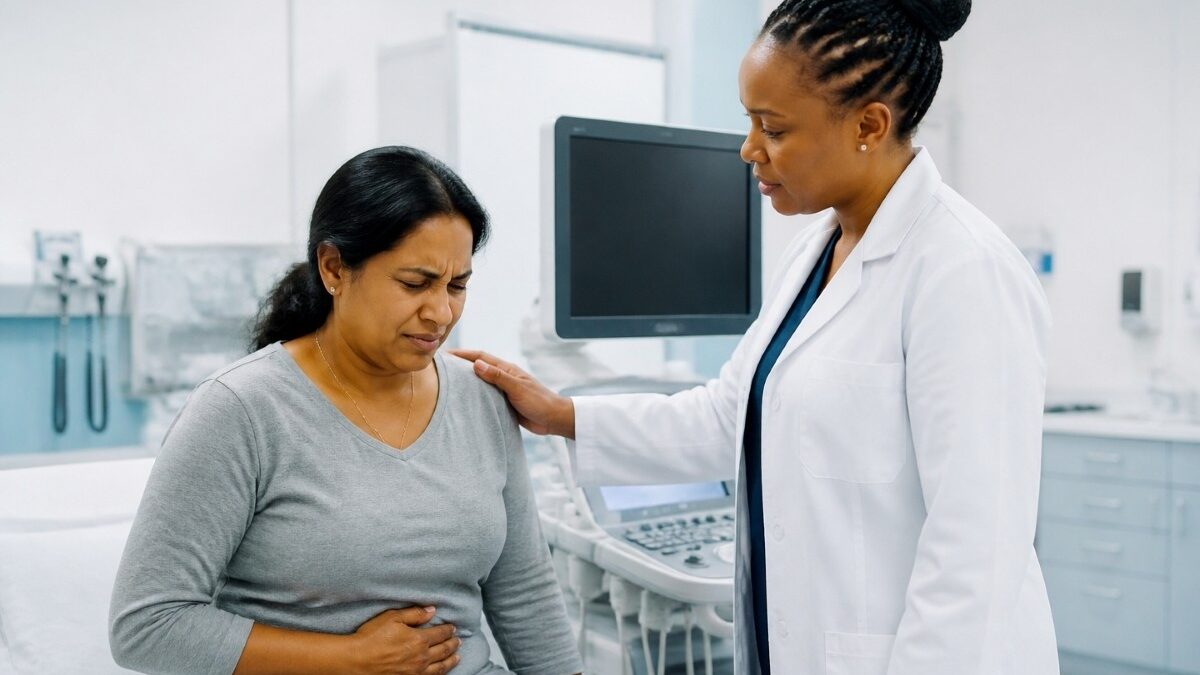
At Life Savers ER, there is no wait to be seen, which matters when the concern is internal bleeding. A board-certified physician will ask about your symptoms, your last period, and whether pregnancy is possible. A pregnancy test and a blood count are usually the first labs drawn, and the on-site laboratory returns results in minutes rather than hours.
Ultrasound is the main imaging tool for pelvic emergencies. It can show a pregnancy inside or outside the uterus, blood flow to the ovaries, fluid in the pelvis from a rupture, and the size of any cysts or fibroids. A CT scan may be used if the cause of the pain is not clear. All of this imaging is available on-site at every Life Savers ER location, and it is read by board-certified radiologists.
Treatment depends on what is found. Fluids and medication are used to control bleeding and may be started right away. Some patients can be stabilized and sent home with a follow-up plan. Others, such as those with a ruptured ectopic pregnancy or a twisted ovary, need surgery, and the team will arrange a direct transfer to a hospital so no time is lost.
Trust your instincts about your own body
Women often talk themselves out of coming in because their pain “might just be cramps.” Severe pain, heavy bleeding, and dizziness are not normal period symptoms, and pregnancy makes any of them more urgent. If you are in the Houston or Sugar Land area and something feels wrong, check in online or come straight to the nearest Life Savers ER. We are open 24 hours a day, every day of the year, and there is never a wait to be seen.